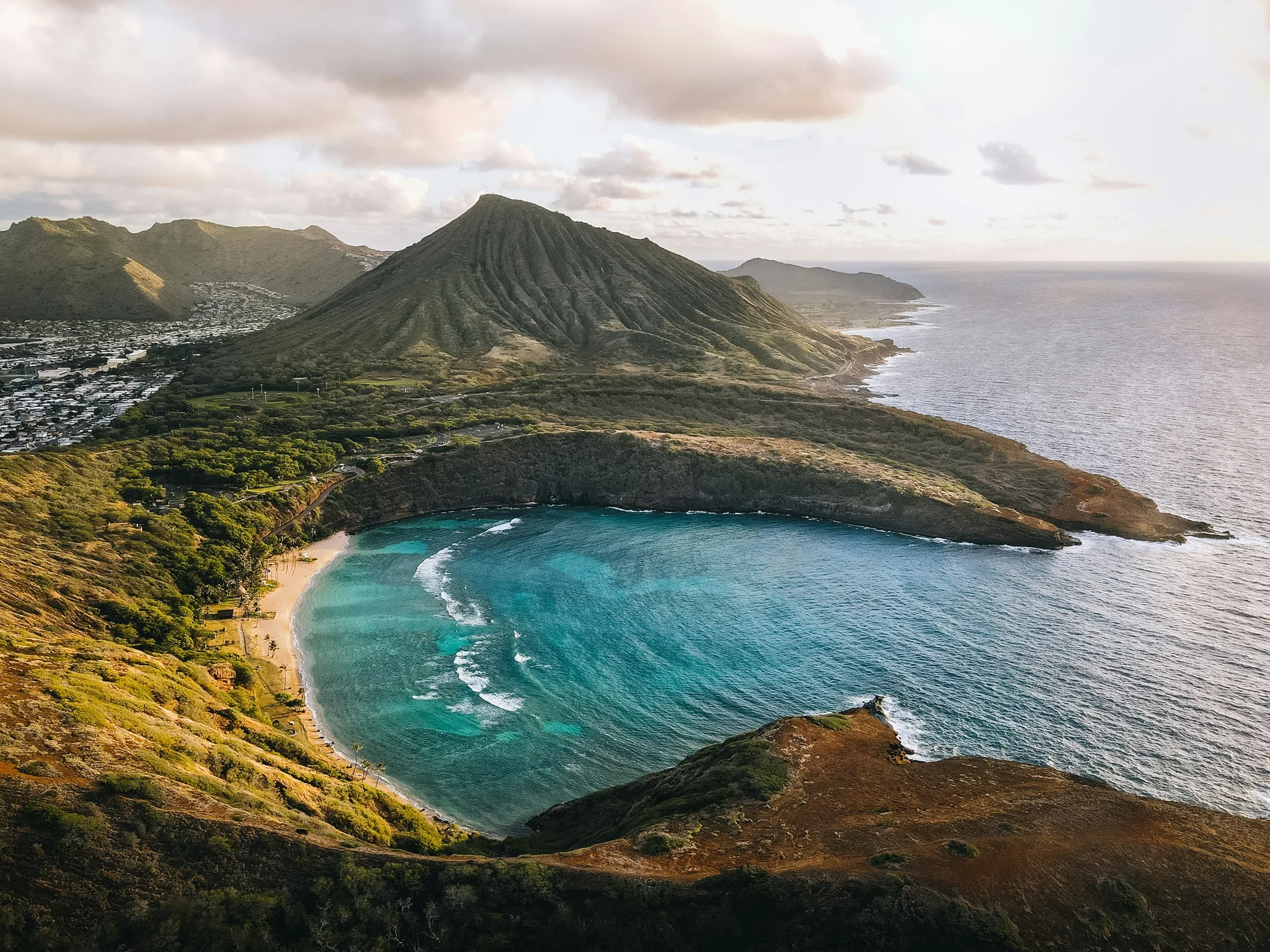


Most Oʻahu trips begin in a familiar rhythm: land in Honolulu, find your way to Waikīkī, look up at Lēʻahi, maybe plan a day for Pearl Harbor, the North Shore, or the windward side. It is easy to move through all of that as scenery.
A little watching and reading before you go changes the trip. Not because you need homework to enjoy the beach, but because Oʻahu rewards context. This is the island where the Hawaiian Kingdom’s political center stood, where tourism’s most famous image was manufactured, where military history sits beside surf culture, and where Native Hawaiian scholarship and activism have shaped modern conversations far beyond the island.
The goal is not to memorize names and dates. It is to arrive with a better ear.
Start with Waikīkī as a place, not just a resort district
If you are staying on Oʻahu, there is a good chance Waikīkī will shape your first impression. That makes it worth looking at carefully before you arrive.
“Waikiki” — Christopher Kahunahana
Christopher Kahunahana’s film is not an easy vacation warm-up, and that is exactly why it belongs here. “Waikiki” follows a Native Hawaiian woman moving through contemporary Honolulu, where the polished visitor image of Waikīkī collides with exhaustion, instability, memory, and grief.
Watch it because it refuses the soft-focus version of Hawaiʻi that visitors are often sold. The Waikīkī of postcards is present, but it is not the whole story. The film asks you to notice who is serving, commuting, being priced out, performing, surviving, and still carrying their own inner life in a place many travelers experience only as leisure.
“Blue Hawaii” — as a tourism artifact, not a guide
Elvis Presley’s “Blue Hawaii” is useful if you watch it with the right lens: not as cultural education, but as evidence.
The film helped export a fantasy of Hawaiʻi that still lingers: easy romance, endless music, cheerful service, tropical beauty without political context. You do not need to watch the whole thing unless you enjoy the genre. Even a short viewing can be clarifying. Notice what kind of Hawaiʻi is being packaged, who gets interiority, who becomes atmosphere, and how smoothly the islands are turned into a mood.
Then, when you step into modern Waikīkī — with its surf lessons, luxury storefronts, family-run food spots, hotel towers, street performers, and working residents passing through — you may feel the difference between a marketed image and an actual place.
Films and documentaries that give Oʻahu a human center
Oʻahu is often filmed as a backdrop: jungle ridge, city skyline, military base, beach. The better pre-trip choices make people and place inseparable.
“The Haumāna”
“The Haumāna” is a warm, grounded film about hula, teaching, responsibility, and inheritance. Its title refers to students, and the story follows a man drawn into the role of leading a group of young dancers.
For travelers, the value is simple: it presents hula as practice, discipline, relationship, and lineage — not as a hotel-lawn accessory. If the only hula you have seen is staged for visitors, this film widens the frame. It helps you understand why a kumu is not merely an instructor, why choreography can carry memory, and why performance is often the visible tip of a much deeper cultural life.
“Kumu Hina”
“Kumu Hina” follows Hinaleimoana Wong-Kalu, a respected Native Hawaiian teacher and cultural practitioner. The film opens a window into Hawaiian education, gender, identity, and the place of māhū — often described as people who embody both masculine and feminine spirit — within Hawaiian and broader Pacific understandings.
This is a generous film, not a lecture. It is especially valuable because it shows contemporary Hawaiian culture as lived and taught in the present. Visitors often arrive with a museum version of indigeneity, as if Hawaiian culture belongs mainly to the past. “Kumu Hina” makes that impossible.
“Waterman”
If you plan to surf, take a lesson in Waikīkī, or just watch longboarders from the sand, “Waterman” is a useful companion. The documentary centers Duke Kahanamoku, the legendary Native Hawaiian swimmer, surfer, Olympic athlete, and ambassador of surfing.
Duke is often flattened into a statue, a restaurant name, or a smiling symbol of aloha. The better story is more interesting: a Waikīkī waterman who moved through global fame while representing Hawaiʻi in a changing political and racial world. After watching it, the water off Waikīkī feels less like a postcard and more like a living arena of skill, lineage, and public memory.
For the history beneath downtown Honolulu
You do not have to be a history person to feel the weight of central Honolulu. ʻIolani Palace, the old civic core, church steeples, government buildings, and business towers sit close together. Without context, it can blur into a pleasant half-day. With context, the geography becomes much more legible.
“Act of War: The Overthrow of the Hawaiian Nation”
For political history, “Act of War” is one of the clearest starting points. It examines the overthrow of the Hawaiian Kingdom and the events surrounding the loss of Hawaiian sovereignty, with Honolulu at the center of the story.
This is the kind of documentary that changes how you walk. The area around ʻIolani Palace stops feeling like an isolated historic site and starts to read as the stage for decisions whose consequences still shape land, law, identity, and protest in Hawaiʻi.
If your Oʻahu plans include Pearl Harbor but not the history of the Hawaiian Kingdom, your historical picture will be lopsided. Make room for both.
“Hawaiʻi’s Story by Hawaiʻi’s Queen” — Queen Liliʻuokalani
Queen Liliʻuokalani’s own account is essential reading for Oʻahu. You do not need to finish every page before your flight, but read enough to hear her voice directly.
The book gives personal and political texture to a history that is too often summarized from the outside. It also connects strongly to places many visitors pass through: Honolulu, ʻIolani Palace, Washington Place, and the civic landscape of the former Kingdom’s capital.
The prose comes from another era, but the emotional force is immediate. Hawaiian history was lived by people with names, homes, responsibilities, loyalties, and losses.
Books that make modern Oʻahu easier to read
A good Oʻahu reading list should not stay only in the monarchy period. The island you visit today is also shaped by tourism, plantation-era migration, military presence, land struggles, university life, language revitalization, and the daily creativity of local communities.
“From a Native Daughter” — Haunani-Kay Trask
Haunani-Kay Trask’s essays are forceful, uncompromising, and important. This is not a neutral-toned visitor primer. It is a Native Hawaiian critique of colonialism, tourism, militarism, and the ways Hawaiʻi is consumed.
Some readers will find it bracing. Good. Travel writing often tries to keep Hawaiʻi comfortable for outsiders. Trask does not.
Read one or two essays before you go, especially if you are staying in Waikīkī or planning a resort-centered trip. You do not have to agree with every sentence to be changed by the encounter. The point is to hear an influential Hawaiian intellectual and activist on her own terms.
“Waikīkī: A History of Forgetting and Remembering” — Andrea Feeser and Gaye Chan
This is the book to reach for if you want Waikīkī to become more than hotel names and beach access points. It examines the district through memory, art, development, and erasure — the layered process by which a real Hawaiian place became one of the world’s most recognizable tourism images.
Waikīkī can feel so immediate that its past disappears. You see towers, restaurants, surfboards, and crowds. The book helps restore depth: water, land, aliʻi, performance, commerce, displacement, reinvention.
Pair it with an early morning walk before the beach gets busy. The quiet hour does half the teaching.
“Honolulu” — Alan Brennert
For fiction, Alan Brennert’s “Honolulu” offers an accessible way into the city’s multiethnic history through the story of a Korean picture bride in early twentieth-century Hawaiʻi. It is a novel, not a substitute for history, but it gives emotional shape to migration, labor, marriage, ambition, and the making of local community.
Oʻahu’s present-day food, language, neighborhoods, and family histories are deeply connected to waves of immigration and plantation-era life across the islands. This book helps a visitor understand that “local” in Hawaiʻi is not a vague synonym for “Hawaiian.” It is a distinct, layered identity shaped by Native Hawaiian foundation and generations of people from Asia, Europe, the Americas, and the Pacific.
That distinction matters. It makes conversations, menus, and place names easier to hear correctly.
If Pearl Harbor is on your itinerary
Many Oʻahu visitors set aside time for Pearl Harbor, and that history deserves attention. Just try not to let World War II become the only historical frame you bring to the island.
A balanced pre-trip approach might be: one Pearl Harbor documentary or book of your choosing, plus “Act of War” or Queen Liliʻuokalani’s account. That pairing keeps two truths in view: Oʻahu’s role in global military history, and Oʻahu’s place at the center of Hawaiian national history.
The island holds both. Seeing only one makes the other harder to notice.
How this changes an ordinary Oʻahu day
The payoff of this watching and reading is not that you become an expert. You will not. The payoff is that your attention gets better.
In Waikīkī, you may notice the tension between hospitality and exhaustion, spectacle and home. At the beach, you may see surfing not as vacation décor but as a practice with Hawaiian roots and modern local lineages. Downtown, the palace and government buildings may feel less like isolated landmarks and more like pieces of an unfinished political story. On the drive across the island, the military presence, suburban neighborhoods, Koʻolau ridges, shopping centers, churches, schools, and beach parks may start to feel connected rather than random.
Choose two or three titles, not twelve. Mix one difficult piece with one generous one. Leave some room for the island itself to complicate what you learned. Oʻahu is not a syllabus, and your vacation should still feel like a vacation.
But if you arrive having listened to a few of the right voices, the place will meet you differently.
Further Reading
A few relevant next steps from Alakai Aloha.
 BlogWhat to Watch Before Your Oʻahu Flight
A smart Oʻahu pre-trip watchlist with films and shows that bring Waikīkī, the North Shore, island history, and blockbuster landscapes into sharper focus.
Editor's pick GuideBest Oʻahu Luaus & Cultural Experiences
A guide to best Oʻahu luaus.
Editor's pick ActivityIolani Palace
Explore the only official state residence of royalty in the U.S., immersing yourself in the rich history of the Hawaiian monarchy and its pivotal role in island culture.
Editor's pick Hawaii-wide guideThe Hawaiian Language Revival (ʻŌlelo Hawaiʻi)
If you spend a few days in Hawaiʻi and pay attention, you will hear the language before you understand it. In place names. In mele. In the way a flight attendant says mahalo. In the careful pause of an ʻokina in...
Editor's pick